

8 Key Signs Your Forklift Battery Is Losing Efficiency
8 Critical Indicators Your Forklift Battery Needs Immediate Attention
Every moment your forklift is sidelined costs your operation valuable revenue. Your forklift battery is the silent engine driving your productivity. Recognizing the signs that your forklift battery is losing its edge allows you to tackle issues before they bring your lifts and shipments to a standstill. This guide unveils 8 key warning signs, from diminished runtime and physical wear to chemical breakdown and overheating, alongside practical advice on maintenance, troubleshooting, and replacement. We’ll delve into common failure symptoms, how to spot external damage and sulfation, make informed decisions about repair versus replacement, mitigate thermal risks, implement a solid care routine, perform basic diagnostics, and take swift safety actions. By the end, you’ll be equipped to know precisely when to call in Swift Power’s expert forklift battery service and maintenance to safeguard your uptime and maximize your battery’s lifespan.
What Are the Most Common Signs of Forklift Battery Failure?
Forklift battery failure typically announces itself through operational and visual cues that signal a drop in capacity, voltage fluctuations, and alerts on the control panel.
- Reduced Runtime and Rapid Discharge
- Slow Charging or Failure to Hold Charge
- Dim Display and Sluggish Forklift Performance
Spotting these early warnings helps you head off more serious problems like corrosion or sulfation, which we’ll examine next as we inspect the battery’s exterior and internal components.
Key Signs of Forklift Battery Failure
A shorter runtime, sluggish charging, and dim displays are common indicators that your forklift battery is faltering. These symptoms often point to internal chemical shifts, necessitating a thorough physical inspection.
How Does Reduced Runtime and Fast Discharge Indicate Battery Inefficiency?
Reduced runtime occurs when the battery’s capacity its total amp-hour output dips below its designed specifications, leading to rapid power depletion that hinders continuous operation. As capacity wanes, electric forklifts demand more frequent charging, disrupting workflows and escalating energy expenses.
- An abrupt drop in runtime of 20–30 percent within a single shift
- Unexpected shutdowns even when handling light loads
- Inability to complete planned tasks without a recharge
These rapid discharge symptoms foreshadow potential plate damage or sulfation, prompting us to look closer at charging behavior.
Why Is Slow Charging or Not Holding Charge a Warning Sign?
Slow charging emerges when internal resistance climbs often due to sulfate crystal buildup or degraded cell plates, preventing the battery from reaching its full charge potential. A battery that consistently fails to reach full voltage, even with a correct charging regimen, offers reduced capacity and a shortened productive lifespan.
Extended charge times directly curtail equipment availability and signal a clear need for maintenance or more significant intervention.
What Does Dim Display and Reduced Forklift Performance Reveal?
Dim instrument panels and sluggish lift or travel speeds are tell-tale signs of voltage sags under load, reflecting diminished cell efficiency and a decline in power transfer. When the forklift’s control system detects low voltage thresholds, it dims the display and shifts into protective performance modes to safeguard the battery.
- Faded dashboard backlighting during operation
- Noticeable reductions in power modes (e.g., low-power or eco modes engaged)
- Delayed lift response and slower travel speeds
These visual cues often accompany internal chemical changes within the battery, making a physical inspection for external damage and corrosion a logical next step.
Understanding the Role and Types of Industrial Batteries
Industrial batteries are the workhorses of commercial and industrial operations, providing reliable, high-power energy for a wide range of applications beyond consumer electronics. Unlike the batteries in your TV remote, these are built for longevity, durability, and a high number of charge cycles. While this article focuses on electric forklift batteries, it’s important to understand they are a specific type of industrial battery. The principles of maintenance and failure indicators like sulfation, overheating, and reduced runtime apply broadly to other large-scale battery systems.
Think of an industrial battery as the heart of a machine or system. For an electric forklift, the forklift battery provides the necessary power to lift heavy loads and move quickly across a warehouse floor. This is a demanding application, which is why forklift batteries are engineered to be robust.
Another key application for industrial battery technology is in backup power systems, telecommunications, and even renewable energy storage. The lessons learned from maintaining electric forklift batteries are highly transferable. For instance, just as a sulfated forklift battery loses efficiency, a backup power system with sulfated cells will fail to provide power when a blackout occurs. Regularly checking voltage, specific gravity, and temperature is crucial for all types of industrial batteries to ensure they perform reliably when needed. Understanding these commonalities allows for a more holistic approach to power management and maintenance across an entire operation.
How Can You Identify Physical Damage and Corrosion on Your Forklift Battery?
Physical damage and corrosion significantly threaten your forklift battery’s structural integrity, operational efficiency, and workplace safety. Damage to the battery casing or internal components, such as cracks or bulging from gas buildup, can compromise performance and increase the risk of hazardous acid leaks. Similarly, corrosion, often appearing as white or greenish powdery deposits on terminals and connectors, results from acid vapor reactions and obstructs electrical current flow, leading to voltage drops and reduced forklift performance. Early detection through regular, thorough inspections is essential to address these issues before they escalate into costly repairs or safety risks. During inspections, look for signs like cracked or distorted casings, which may indicate internal faults. Check terminals and cables for corrosive buildup, as well as frayed or loose connections that disrupt power delivery. By staying proactive and addressing these warning signs promptly, you can maintain reliable fleet operations and prevent unexpected downtime.
What Are the Signs and Risks of Battery Terminal Corrosion?
Terminal corrosion occurs when acid vapors interact with metal posts, creating deposits of lead sulfate or copper sulfate that elevate contact resistance.
- A white or greenish powdery substance forms around the posts
- Flaky or crusty buildup on clamp surfaces
- A measurable voltage drop occurs when the industrial battery is under load
Corroded terminals restrict current flow, leading to cell imbalance and overheating, issues we’ll explore further when discussing chemical sulfation.
How to Detect Acid Leaks or Spilled Electrolyte Safely?
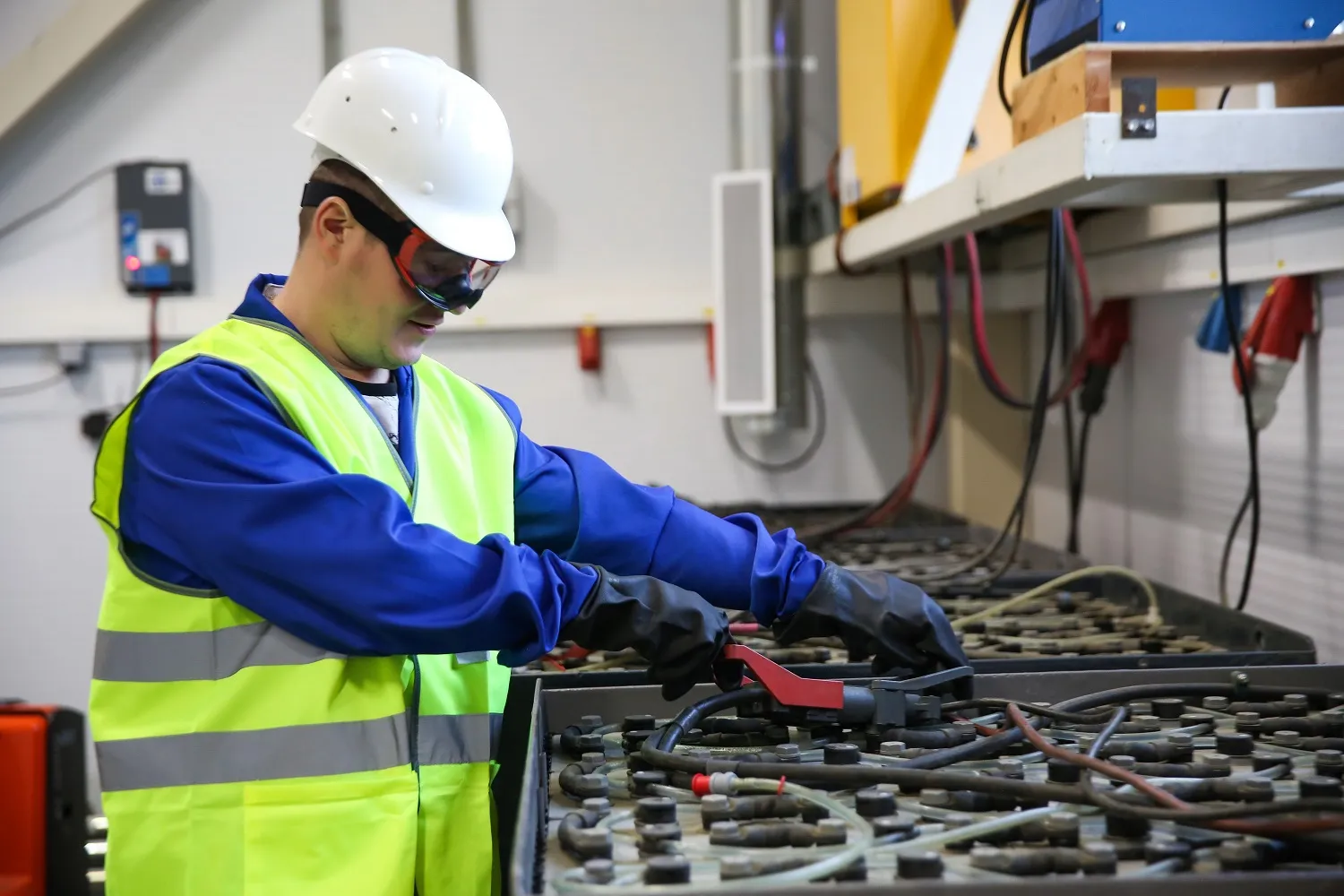
Acid leaks can stem from overfilling, cracked casings, or loose cell caps, posing both performance and safety risks. Always equip yourself with acid-resistant gloves, eye protection, and rubber boots before inspecting.
- Don your full personal protective equipment (PPE) before approaching the battery.
- Visually inspect the battery tray and the surrounding floor for any wet or discolored patches.
- Sniff for sharp, vinegar-like odors emanating from the vent caps.
- Use pH test strips to check the floor’s acidity and confirm the presence of electrolytes.
Swiftly detecting and neutralizing leaks with a baking soda solution prevents further corrosion and prepares the ground for assessing cell deformation, such as swelling.
What Does Battery Swelling or Bulging Indicate About Battery Health?
Swelling or bulging of the battery case is a consequence of gas buildup from overcharging or internal faults, which distorts the casing and strains the seals. This deformation signals irreversible damage and a significant safety hazard.
- Case expansion along the edges
- Visible bowing of the battery case
- Audible hissing as gases attempt to escape
Bulging indicates compromised plate alignment and a heightened risk of internal short circuits, rendering sulfation treatments less effective and often necessitating a full replacement.
What Causes Excessive Sulfation and How Does It Affect Battery Efficiency?
Excessive sulfation occurs when lead sulfate crystals build up on forklift battery plates, hindering contact with the electrolyte and reducing capacity. This issue arises from operating batteries at a partial charge (below 80%), insufficient electrolyte levels due to irregular watering, or skipping equalization cycles that balance cell chemistry. Prolonged storage or high temperatures can worsen the problem, causing crystals to harden. As sulfation progresses, it limits power output, increases internal resistance, and leads to shorter runtimes and slower charging, disrupting operations and raising energy costs. Early intervention through proper charging and maintenance can prevent severe sulfation. For advanced cases, Swift Industrial Power offers expert desulfation services to restore battery efficiency and ensure reliable fleet performance.
Forklift Battery Sulfation Explained
Sulfation, characterized by the accumulation of lead sulfate crystals on battery plates, degrades the performance of lead-acid batteries. This process is accelerated by factors such as undercharging, exposure to high storage temperatures, and extended periods of inactivity.
How Does Sulfation Develop in Lead-Acid Forklift Batteries?
Sulfation begins when the battery consistently remains below an 80 percent state of charge, allowing lead and sulfate ions to crystallize rather than readily redissolving into the electrolyte. Undercharging, prolonged storage, or skipping equalization charges all contribute to this buildup.
This process permanently reduces the available plate surface area, accelerating performance degradation and creating localized electrical hotspots.
What Are the Visual and Operational Signs of Sulfation?
Identifying sulfation in its early stages is crucial to preventing irreversible capacity loss:
- Visible white or gray crystalline residue on plate surfaces (not visible through cell jars)
- Persistent low voltage plateaus even after prolonged charging periods
- An increase in internal resistance, detectable with a conductance tester
The presence of detectable sulfate crystals signals the need for specialized desulfation treatments or professional battery service.
How Can Sulfation Be Prevented or Treated?
Regular equalization charging and maintaining correct electrolyte levels are key to inhibiting sulfate crystal formation. When sulfation is present, professional desulfation devices employ pulsed high-frequency currents to break down these crystals.
- Schedule monthly equalization cycles.
- Keep water levels above the plates, using only distilled water for topping up.
- Utilize desulfation services or approved additives under expert guidance.
Proactive prevention of sulfation ensures the battery maintains its full capacity, thereby reducing the likelihood of unplanned replacements.
When Should You Consider Forklift Battery Replacement vs. Repair?
Deciding between repairing or replacing a forklift battery requires strategically weighing repair costs against the long-term benefits of a new battery to optimize fleet economics. Key factors influencing this decision include the battery’s age, the extent of physical or chemical damage, and its performance metrics, such as capacity and runtime. Batteries older than five years or with severe damage, like extensive sulfation or multiple failed cells, often provide diminishing returns on repairs, making replacement a more cost-effective choice. Repairs, while less expensive upfront, may only extend battery life briefly if underlying issues persist. Conversely, a new battery, though a higher initial investment, restores full operational reliability and often includes warranty coverage. Swift Industrial Power’s experts can assess your battery’s condition and provide tailored guidance to ensure cost-efficient decisions that minimize downtime and maximize your fleet’s productivity.
What Factors Determine the Need for Battery Replacement?
Replacement becomes unavoidable when cumulative damage or the battery’s age surpass its service limits:
- Battery age exceeding five years
- Multiple cell failures
- Persistent sulfation that resists desulfation attempts
At this juncture, investing in a new battery is the most effective way to restore reliable shift operations and benefit from warranty coverage.
How Does Repair Compare to Replacement in Cost and Longevity?
Evaluating whether to repair or replace involves comparing the immediate costs against the expected service life:
Repair offers a short-term fix at a lower initial cost, while replacement or a lithium forklift battery-ion upgrade provides enduring uptime and reduced lifetime maintenance expenses.
What Are the Benefits of Upgrading to Lithium-Ion Forklift Batteries?
Lithium-ion batteries deliver superior energy density, exceptionally fast recharge times, and an extended cycle life. They eliminate the need for watering and are capable of supporting multi-shift operations without requiring lengthy cooling periods.
- Recharge fully in 1–2 hours, managed by integrated battery management systems
- Maintain consistent voltage and runtime regardless of load demands
- Achieve maximum cycles with minimal degradation in capacity
These key benefits directly lead to more efficient workflows and reduced total ownership costs. Read this Lead-Acid vs. Lithium-Ion Forklift Batteries guide for more details.
How Does Overheating Affect Forklift Battery Performance and Safety?
Overheating poses a serious threat to forklift battery performance and operator safety by accelerating internal degradation and creating hazardous conditions. Excessive heat speeds up plate corrosion, reducing the battery’s ability to hold a charge and causing electrolyte loss, which diminishes capacity and runtime. This degradation leads to inefficient power delivery, forcing more frequent recharges and disrupting operational workflows.
More critically, overheating increases the risk of thermal runaway, a dangerous condition where escalating temperatures can cause acid boiling or even battery failure, posing significant safety hazards to operators and nearby equipment. Factors like high ambient temperatures, overcharging, or heavy continuous use without cooling breaks exacerbate these issues. Regular monitoring for signs like elevated battery surface temperatures or unusual odors, combined with proper charging protocols, can mitigate risks.
What Causes Battery Overheating During Use or Charging?
Excessive current draw, internal short circuits, or charging at an overly high voltage can cause cell temperatures to spike. High ambient temperatures and insufficient ventilation can exacerbate these effects.
Operating in warm warehouse environments or performing continuous heavy lifts without adequate cooling breaks places undue stress on the battery, pushing it beyond safe temperature limits.
What Are the Signs of Overheating to Watch For?
Overheated batteries exhibit distinct and critical warning signals:
- Surface temperatures exceeding 50 °C (122 °F) under normal operating load
- A pungent odor or visible steam escaping from the vent caps
- A sudden and dramatic voltage collapse during a shift
Identifying these indicators promptly is essential to prevent cell warping and the dangerous condition of acid boiling.
How Can Overheating Be Prevented or Mitigated?
Implementing proper cooling and charging protocols is vital for maintaining optimal battery temperatures:
- Ensure unobstructed airflow around the battery compartment.
- Utilize manufacturer-specified charge currents and voltage limits.
- Equip high-capacity fleets with temperature sensors and alarms.
Effective thermal management is crucial for sustaining consistent efficiency and preventing irreversible thermal damage.
How Can Regular Maintenance Extend Your Forklift Battery’s Lifespan?
Proactive maintenance is essential for extending the lifespan of your forklift battery by preserving the health of battery plates, maintaining electrolyte balance, and ensuring full capacity for consistent performance. Regular care prevents issues like sulfation, corrosion, and cell imbalance, which can prematurely degrade the battery and lead to costly downtime. By adhering to a disciplined maintenance routine, including timely watering with distilled water, cleaning terminals to remove corrosive buildup, and performing equalization charges, you can significantly enhance battery efficiency and durability. These practices optimize power delivery, reduce the need for frequent recharges, and delay the expense of electric forklift batteries, maximizing the return on your power investment.
What Are Essential Forklift Battery Maintenance Tasks?
Consistent, routine care tasks are fundamental to achieving peak performance and identifying potential issues early:
- Check and replenish electrolyte levels weekly using only distilled water.
- Inspect and clean terminals regularly to eliminate any signs of corrosion.
- Perform monthly equalization charges to ensure all cells are balanced.
Essential Forklift Battery Maintenance
Regular maintenance, including checking electrolyte levels, cleaning terminals, and conducting equalization charges, is vital for extending the operational life of your forklift battery. Adhering to proper charging protocols also plays a significant role in maintaining full capacity.
How Does Proper Charging Regimen Improve Battery Efficiency?
Strictly following correct charge and discharge protocols prevents both undercharging and overcharging, thereby preserving the battery’s full capacity:
- Charge the battery immediately after each use to avoid deep discharge states.
- Strive to complete full charge cycles whenever feasible, avoiding partial charges.
- Adhere meticulously to the manufacturer’s recommended voltage and time guidelines.
A disciplined charging schedule ensures that every amp-hour is fully restored and ready for the demands of the next operational shift.
When Should You Schedule Professional Battery Service?
Engage expert technicians for diagnostics when internal issues persist despite routine maintenance or when cells exhibit noticeable imbalance:
- Voltage differentials exceeding 0.1 V between individual cells
- Repeated occurrences of sulfation even after desulfation attempts
- Visible signs of swelling, acid leaks, or significant terminal damage
That’s why professional forklift battery service is crucial for addressing emerging problems before they lead to costly, unplanned downtime.
What Troubleshooting Steps Can Help Diagnose Forklift Battery Issues?
Implementing a structured diagnostic approach is crucial for quickly identifying the root causes of forklift battery issues, enabling targeted corrective actions that minimize guesswork and preserve operational uptime. By systematically assessing battery performance, you can pinpoint problems like voltage irregularities, cell imbalances, or charger malfunctions that impact efficiency. Start by measuring open-circuit voltage with a digital multimeter to detect low charge levels, followed by checking electrolyte specific gravity with a hydrometer to evaluate cell health. Conducting a load test further reveals how the battery performs under operational stress, highlighting issues like capacity loss or internal resistance. These steps help differentiate between battery-related problems and external factors, such as faulty chargers or damaged cables.
How to Test Forklift Battery Health Using Common Tools?
Basic diagnostic tools can reveal a battery’s capacity and cell condition within minutes:
- Utilize a digital multimeter to measure the open-circuit voltage.
- Check the specific gravity of the electrolyte in each cell using a hydrometer.
- Conduct a load test to observe voltage behavior under a known current draw.
These tests are instrumental in pinpointing underperforming cells and informing decisions regarding repair or replacement.
What Are Common Charging Problems and How to Identify Them?
Charging faults can range from malfunctioning chargers to issues with the battery’s ability to accept a charge:
- Observe slow or no-charge events, especially when charger indicator lights signal errors.
- Note any charger temperature warnings or fan errors that suggest internal failures.
- Check for intermittent connections caused by corroded clamps or damaged cables.
Accurately distinguishing between charger faults and battery issues ensures that the correct component receives the necessary attention.
How Do Lead-Acid and Lithium-Ion Batteries Differ in Troubleshooting?
Troubleshooting lead-acid batteries typically involves checking specific gravity and voltage, whereas lithium-ion systems rely on diagnostics provided by their integrated Battery Management System (BMS):
- Lead-acid: Requires hydrometer readings and cell equalization tests.
- Lithium-ion: Involves interpreting BMS error codes and checking cell voltage balancing.
Tailoring diagnostic methods to the specific battery chemistry significantly accelerates fault isolation and resolution.
What Immediate Actions Should You Take When You Notice Battery Efficiency Loss?
Responding swiftly to signs of battery efficiency loss is vital to prevent safety hazards, avoid further damage, and protect both equipment and personnel. When you observe symptoms like reduced runtime, sluggish performance, or charging issues, immediate action can mitigate risks such as acid leaks, overheating, or operational downtime. Begin by safely inspecting the battery for visible damage, such as corrosion or leaks, using proper protective equipment to ensure operator safety. Next, verify charging conditions to rule out external factors like faulty chargers or improper settings. Documenting performance metrics, such as voltage or runtime, helps identify the severity of the issue for informed decision-making. These steps stabilize the situation and pave the way for professional assessment.
How to Safely Handle Acid Leaks and Corrosion?
Neutralize and clean up spills with appropriate safety measures:
- Apply an acid-neutralizing solution (such as a baking soda mixture) while wearing full PPE.
- Contain spilled electrolyte using drip trays or absorbent pads.
- Rinse affected areas thoroughly with water and allow them to dry completely before resuming operation.
- Inspect terminals and cables for corrosion once the area is neutralized and clean.
Prompt safety actions restore a secure environment and enable a clear assessment of any underlying issues.
When to Contact Professionals for Battery Assessment and Service?
Call in expert technicians when in-house solutions prove ineffective or when risks escalate:
- Persistent sulfation or cell imbalance that continues after maintenance efforts.
- Bulging battery cases or evidence of internal gassing despite correct charging practices.
- Recurring overheating incidents occur under normal operating conditions.
Professional technicians possess specialized desulfation systems, cell replacement protocols, and thermal analysis tools to effectively restore battery health.
How Can Swift Power’s Battery Services Help Restore Forklift Performance?
Swift Power offers comprehensive forklift battery service and maintenance solutions, including expert diagnostics, advanced desulfation treatments, terminal restoration, and strategic guidance on replacement decisions. For a detailed analysis of when replacement is the optimal choice, consult or read our guide on warning signs you need to replace forklift batteries and proactively prevent unplanned downtime.
Effectively addressing these critical warning indicators ensures your electric forklifts remain in peak operating condition, safeguards operator safety, and supports uninterrupted productivity. Maintain constant vigilance, adhere to best-practice maintenance routines, and partner with Swift Power’s experts to extend your battery’s lifespan and minimize your total cost of ownership.
Conclusion
Recognizing the critical indicators of forklift battery failure, such as reduced runtime, slow charging, and physical damage, is essential for maintaining operational efficiency, ensuring workplace safety, and preventing costly disruptions. By proactively addressing these warning signs through regular maintenance and timely interventions, you can significantly extend your battery’s lifespan and optimize fleet performance. Consistent care and professional support help mitigate risks such as corrosion, sulfation, or overheating, ensuring your operations run smoothly. Don’t let battery issues derail your productivity. Take action now to safeguard your investment. Contact Swift Industrial Power today to explore our expert maintenance and diagnostic services, designed to enhance your fleet’s reliability, minimize downtime, and ensure long-term operational success.
Servicing Tennessee, Florida, and Alabama