Forklift Battery Service: Ideal Maintenance Intervals
Mastering Forklift Battery Service Intervals: Your Blueprint for Peak Performance and Extended Lifespan
Uninterrupted power is the engine of every material handling operation, and your forklift batteries are the heart of that productivity. Sticking to recommended service intervals isn’t just about avoiding surprises; it’s your key to helping you extend forklift battery life by up to 30 percent and unlocking significant cost savings. Dive into this guide to uncover:
- Why consistent maintenance schedules are non-negotiable for peak efficiency
- A precise daily-to-annual maintenance roadmap
- Essential strategies for charging, watering, equalization, cleaning, and safety
- How Swift Power’s Easy Energy service guarantees flawless adherence to optimal intervals
Why Are Consistent Forklift Battery Maintenance Intervals Essential for Operational Flow?
Regular forklift battery maintenance is a dual-action strategy: it’s both preventative care and performance validation. This approach safeguards your energy capacity and eliminates costly, unplanned downtime. By keeping cells balanced, preventing sulfation, and maintaining optimal specific gravity, you ensure your lift trucks keep running smoothly. For instance, operations that embraced weekly and monthly routines reported a 20 percent reduction in battery-related interruptions within just six months.
Pro Tips for Electric Forklift Battery Care
Consistent upkeep of your forklift batteries is paramount for maximizing their operational life and sidestepping unexpected shutdowns. Integrating a detailed battery maintenance program into your standard operational procedures is a smart move.
This insight underscores the critical role of regular maintenance for forklift batteries, perfectly aligning with our focus on establishing and adhering to essential service intervals.
How Does a Structured Maintenance Plan Extend Forklift Battery Longevity?
Scheduled maintenance works by balancing cell voltages through carefully controlled equalization and electrolyte adjustments, which prevents premature plate wear. By diligently removing sulfate buildup and maintaining the correct acid concentration, your batteries retain more of their original power capacity over thousands of charge cycles.
What Happens When You Skip Forklift Battery Service Intervals?
Ignoring your service schedule invites a cascade of problems: sulfation, acid stratification, corrosion, diminished charge acceptance, and ultimately, irreversible capacity loss. Batteries that are neglected can fail mid-shift, creating bottlenecks in your production line and driving up replacement expenses.
What’s the Potential Savings from Diligent Battery Maintenance?
Implementing a rigorous maintenance schedule can slash your annual battery replacement and energy expenditures by up to 25 percent. Many organizations find that the investment in service pays for itself through extended cell life and reduced downtime within the first year alone.
What Constitutes the Ideal Forklift Battery Maintenance Schedule?
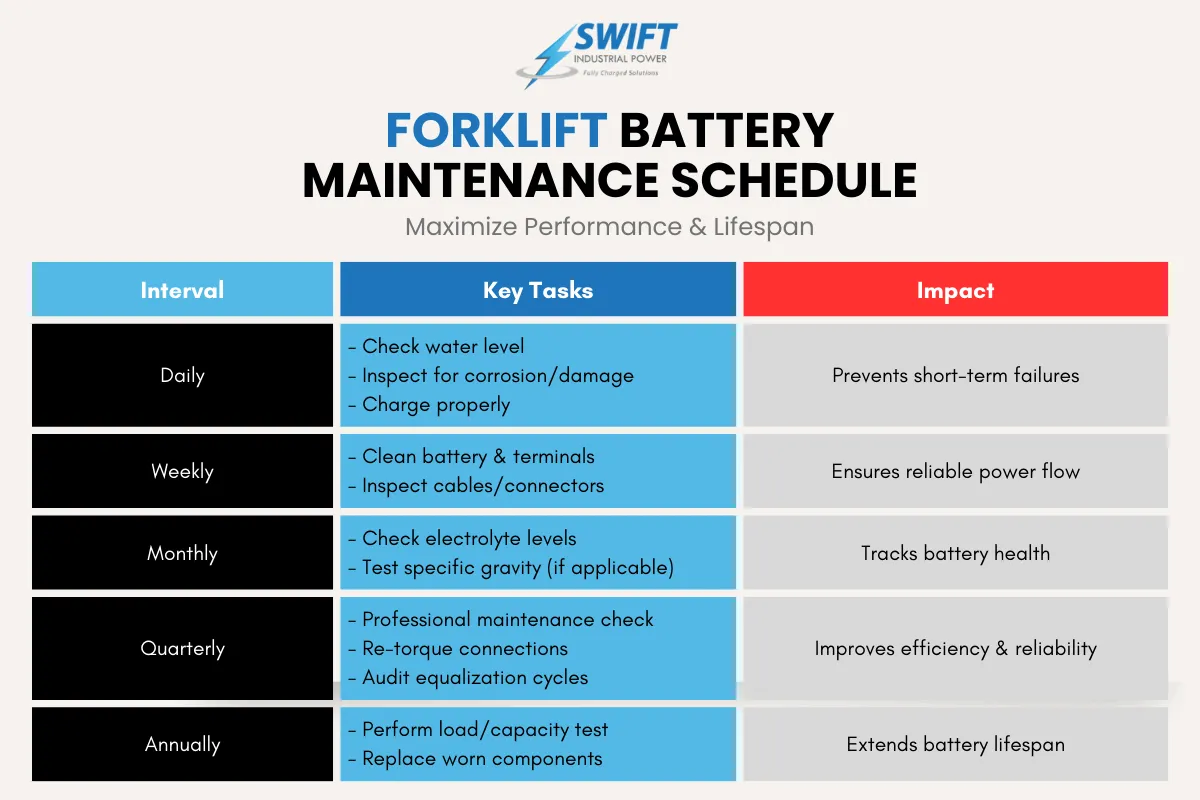
An optimal forklift battery maintenance schedule incorporates tasks across five critical intervals daily, weekly, monthly, quarterly/bi-annually, and annually to guarantee peak performance and maximum lifespan. The table below breaks down the essential actions for each interval and their direct impact on performance.
Your Essential Forklift Battery Maintenance Checklist
A comprehensive forklift battery maintenance checklist includes weekly tasks like checking electrolyte levels and monthly duties such as inspecting for corrosion. Regular equalization charges are highly recommended to prevent inefficiencies and stratification.
Adhering to this schedule empowers your facility to identify emerging issues early and plan for replacements strategically, effectively eliminating the need for emergency interventions.
How Should You Charge Forklift Batteries for Maximum Performance?
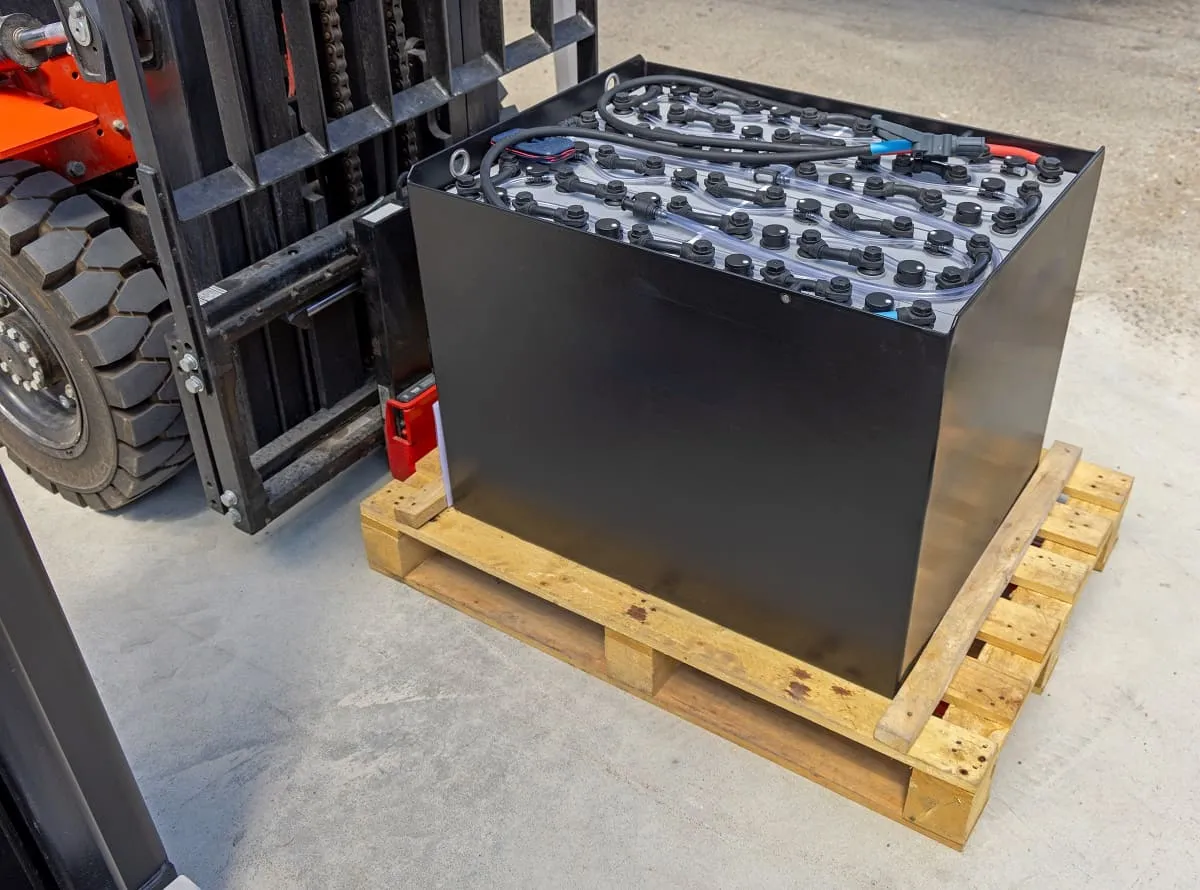
Implementing proper charging protocols ensures your batteries deliver their full power potential without compromising the integrity of the cell plates. Initiating a charge when the battery reaches a 20–30 percent discharge level prompts the next cycle before deep depletion occurs, thereby preserving the active material. Overcharging leads to excessive water loss and plate corrosion, while undercharging promotes sulfation.
- Commence charging once the battery hits a 20–30 percent discharge mark to sidestep deep cycle stress.
- Utilize a charger equipped with adjustable voltage cutoff to prevent overcharging and conserve electrolyte levels.
- Complete full charge cycles to ensure cell voltages are equalized and capacity is maintained.
- Keep a close watch on battery temperature; avoid charging below 50 °F or above 95 °F to prevent thermal damage.
- Verify charger compatibility, ensure the battery’s voltage and amp-hour rating align with the charger to prevent inefficiencies.
Smart Forklift Battery Charging: Do’s and Don’ts
Adopting best practices for charging, such as recharging after an eight-hour shift or when discharged beyond 30%, is fundamental to maintaining battery health and extending its service life. Steer clear of charging during brief breaks or interrupting ongoing charge cycles.
Following these guidelines enhances recharge acceptance, minimizes energy waste, and bolsters long-term capacity retention.
What Are the Best Practices for Forklift Battery Watering and Electrolyte Management?
Maintaining the correct electrolyte levels is crucial for consistent conductivity and balanced cell performance. If watering is neglected, the acid concentration increases, exposing the plates and accelerating sulfation.
Always fully charge the battery before watering to prevent overflow and ensure accurate level readings. Use only distilled or deionized water to prevent mineral contamination, which can degrade plate material. Modern forklift battery watering systems and other automated solutions offer precise fill volume control, significantly reducing labor and the potential for human error.
- Check electrolyte levels immediately after a full charge, once the fluid has settled.
- Add deionized water until the level is just above the plate tops.
- Look for signs of depletion or darkening electrolyte, which can indicate sulfation or contamination.
- Consider installing an automated watering system to maintain consistent levels across all cells effortlessly.
Consistent watering preserves cell integrity, prevents stratification, and maintains peak conductivity, setting the stage for effective equalization.
What Are the Battery Watering Mistakes to Avoid?
Knowing the common battery watering mistakes to avoid is essential for maintaining battery health and performance. Key errors include:
- Watering before charging: This can cause overflow as electrolyte levels rise during charging.
- Using tap water: Minerals and impurities accelerate corrosion and damage plates. Always use distilled or deionized water.
- Overfilling cells: Excess fluid can leak, causing corrosion and safety hazards.
- Inconsistent watering schedules: Neglecting regular checks leads to sulfation and uneven performance.
Avoiding these mistakes and using forklift battery watering systems where possible ensures safe, efficient, and long-lasting battery operation.
What Is Battery Equalization and How Does It Benefit Forklift Health?
Battery equalization for forklifts is a controlled process designed to maintain optimal battery performance. Key benefits include:
- Balances cell voltages: Applies a slightly higher voltage than standard charging to all cells, ensuring uniform performance.
- Reverses minor sulfation: Dissolves sulfate buildup on plates, restoring lost capacity.
- Prevents acid stratification: Circulates electrolyte to prevent plate starvation from uneven acid distribution.
- Accurate monitoring: Allows precise measurement of each cell’s specific gravity for early detection of issues.
- Supports heavy usage: Weekly equalization is especially effective in facilities with high daily forklift activity.
- Extends battery life: Maintains capacity retention, improves recharge acceptance, and helps extend forklift battery life.
Regular battery equalization for forklifts sustains capacity retention, improves recharge acceptance, and helps extend forklift battery life significantly.
What Are the Essential Techniques for Forklift Battery Cleaning and Corrosion Prevention?
Keeping your battery exteriors clean is vital to prevent acid-induced self-discharge and connection failures. Neutralizing acid spills and removing corrosion safeguards your electrical pathways.
Before cleaning, neutralize any spilled acid with a baking soda solution to halt further damage. Then, use a soft brush and an approved battery-safe cleaner to tackle crusty buildup around posts and terminal clamps. Rinse thoroughly with water and dry completely to eliminate any residual moisture.
- Safely neutralize acid spills using a diluted baking soda solution and rinse thoroughly.
- Scrub terminals, connectors, and cell vents with a cleaning agent specifically approved for batteries.
- Rinse with low-pressure water and ensure all surfaces are completely dry to prevent moisture buildup.
- Apply a light coat of terminal protector compound to inhibit future corrosion effectively.
Consistent cleaning maintains low internal resistance, prevents self-discharge, and ensures reliable current flow, even under the most demanding workloads.
What Safety Protocols Are Crucial During Forklift Battery Maintenance?
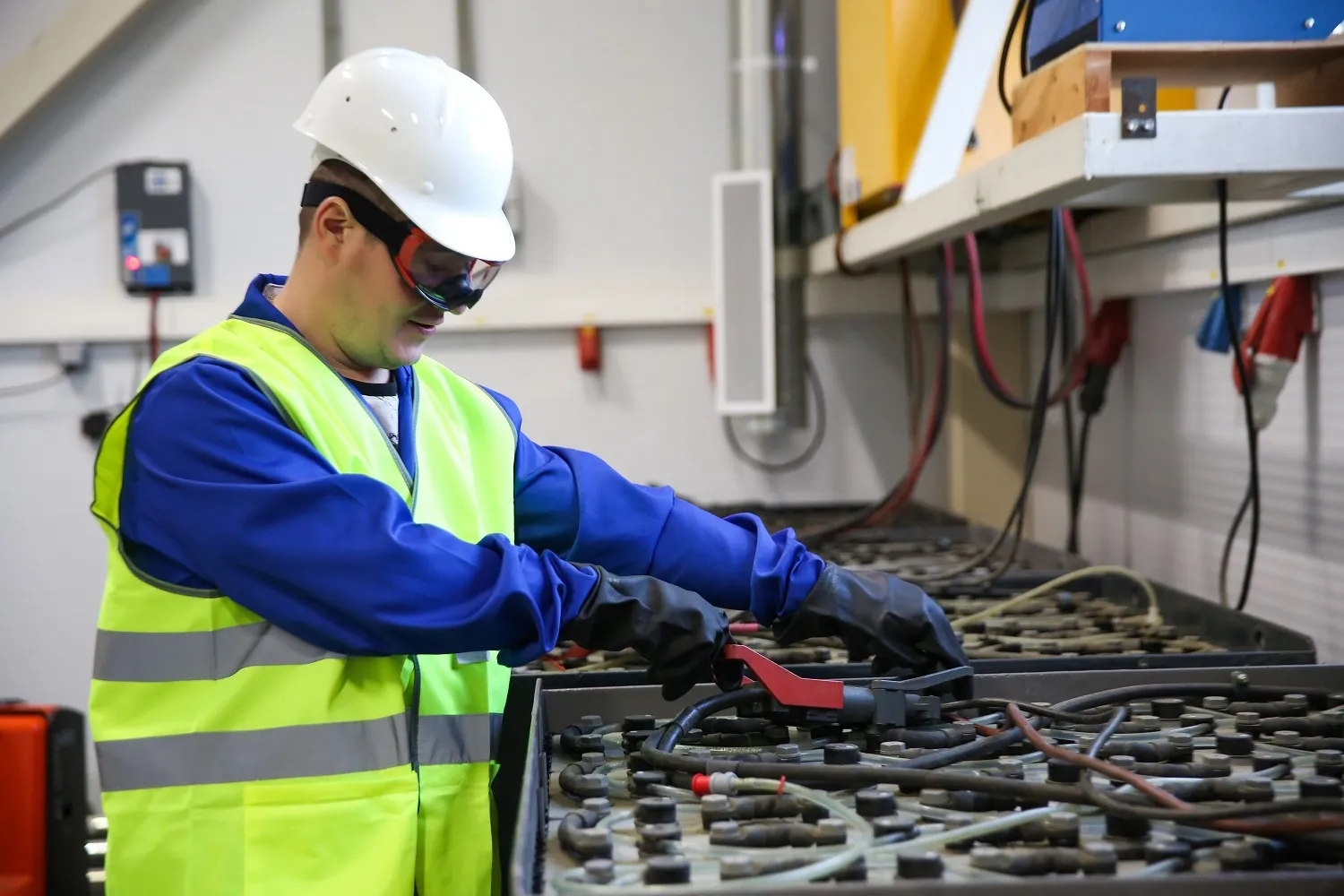
Battery maintenance involves working with corrosive acid, heavy components, and potentially explosive gases. Strict adherence to safety guidelines is essential to protect both personnel and your valuable assets.
- Ensure technicians are fully equipped with appropriate PPE: acid-resistant gloves, safety goggles, and aprons.
- Equip charging stations with explosion-proof lighting and robust forced-air exhaust systems.
- Enforce strict no-jewelry and no-metal policies in the vicinity of batteries to eliminate the risk of dangerous arcs.
- Maintain clear, accessible emergency procedures, including protocols for spill cleanup and first aid.
Implementing these measures guarantees a secure environment for both routine maintenance tasks and any necessary emergency response. Technicians must avoid unsafe shortcuts like adding acid to forklift battery units without guidance, since this poses severe risks to both equipment and personnel.
How Swift Power Ensures Optimal Forklift Battery Maintenance?
Swift Industrial Power’s Easy Energy battery management solution completely removes the complexity of scheduling and executing maintenance tasks. As a comprehensive, turnkey provider, Swift Power supplies batteries, chargers, and expert technicians without requiring any capital investment from your side. This guarantees unwavering adherence to ideal service intervals, freeing you from in-house labor demands. Explore the Forklift Battery Service & Maintenance – Swift Industrial Power program to experience truly hassle-free, performance-driven battery care.
What Are the Key Features of Swift Power’s Easy Energy Battery Management Solution?
Swift Power’s Easy Energy program encompasses scheduled electrolyte checks, the installation of automated watering systems, equalization services, and professional cleaning—ensuring every critical interval is met without fail.
How Do Scheduled Maintenance Contracts Enhance Battery Lifespan and Reduce Downtime?
By engaging in fixed-interval maintenance contracts, companies secure proactive care that effectively prevents battery degradation. Swift Power’s certified technicians meticulously track specific gravity trends and record capacity test results to fine-tune services, extending battery lifespans by up to 30 percent and significantly reducing unplanned downtime.
What Onsite Service Options Does Swift Power Provide?
Swift Power offers flexible onsite visits, ranging from weekly fluid inspections to comprehensive annual overhauls. Our adaptable service tiers are designed to support everything from small fleets to high-volume depots, ensuring consistent, timely intervals that align perfectly with your operational demands.
How Can Businesses Arrange a Consultation with Swift Power?
To establish a customized maintenance plan tailored to your needs, simply reach out to Swift Power’s dedicated service team by phone or through the online contact form on our website. Our specialists will conduct a thorough assessment of your fleet’s usage patterns and recommend the precise interval schedule required to maximize uptime and your return on investment.
Conclusion
Maintaining optimal forklift battery service intervals is essential for enhancing performance and extending lifespan, ultimately leading to significant cost savings. By adhering to a structured maintenance schedule, you can prevent unexpected downtime and ensure your operations run smoothly. Explore Swift Power’s Easy Energy service to simplify your battery management and maximize efficiency. Take the first step towards hassle-free battery care by contacting our team today.
Servicing Tennessee, Florida, and Alabama