

Commercial Generator Capacity: Key Factors for Accurate Sizing

Commercial Generator Capacity: What to Consider for Accurate Sizing and Reliable Backup Power
Generator capacity determines whether critical systems stay online during a power outage. If the generator is too small, equipment can fail or shut down. If it is too large, you waste capital and fuel. This guide explains how to size a commercial generator correctly using real load calculations. It covers how to calculate total kW, convert kW to kVA, and account for starting versus running power demands. You will learn how reserve capacity, fuel type, site derates, and code requirements affect usable generator output. The guide also compares diesel and natural gas generators, highlights common sizing mistakes, and explains when to use load studies and professional support. With practical examples, tables, and step-by-step checklists, this resource helps facilities engineers, project managers, and operations teams choose a generator that delivers reliable backup power while controlling cost and supporting future growth.
How Do You Calculate Commercial Generator Load Requirements?
Load calculation defines the continuous running capacity plus the largest starting (inrush) demand and an allowance for reserve capacity, producing a target generator size in kW or kVA. The workflow is simple: total steady-state loads, add the highest starting device, convert for power factor to get kVA if required, then apply reserve and site derates. Accurate calculations lower the risk of overload during motor starts and help ensure ATS operation under real conditions. Below are clear calculation steps and a conversion example to make the process repeatable for mixed motor and resistive loads.
Use these steps to develop a defensible load estimate before specifying equipment:
- List every continuous running load and note the nameplate kW or wattage.
- Identify starting wattage for motor-driven equipment; use manufacturer locked-rotor data or accepted multipliers when necessary.
- Convert total kW to kVA by dividing by the selected power factor, then add reserve margin and apply site derates.
What Is the Difference Between Starting and Running Wattage?
Starting wattage (inrush) is the short, high-power draw needed to accelerate motors and compressors to operating speed. Running wattage is the steady power required to keep equipment operating. Motors can draw multiple times their running current during startup. Typical multipliers run from about 3× for soft-started loads up to 7× for locked-rotor conditions, so your generator must be sized or paralleled to withstand worst-case inrush without tripping. Address starting loads by identifying the largest single-start device and either increasing generator capacity, staging startups, or adding soft starters/VFDs to limit peaks. Recognizing this difference leads to practical choices like load sequencing or added reserve capacity.
How Do You Use Load Calculation Methods Like Square Footage and Historical Data?
Square-footage rules of thumb give fast, high-level estimates helpful in early budgeting, but they miss concentrated motor loads and special equipment. Historical utility or generator meter data are far more accurate: log peak demand, assess simultaneous loads, and model startup events to reveal true sizing needs. If reliable historical data aren’t available, deploy temporary meters and run a formal load study that captures real operating cycles and supports realistic reserve sizing. Combining rule-of-thumb planning with data-driven validation balances early budgeting with final equipment selection.
This table separates common equipment by whether starting loads will drive sizing. Correct categorization speeds accurate kW-to-kVA conversions.
What Key Factors Influence Commercial Generator Capacity?
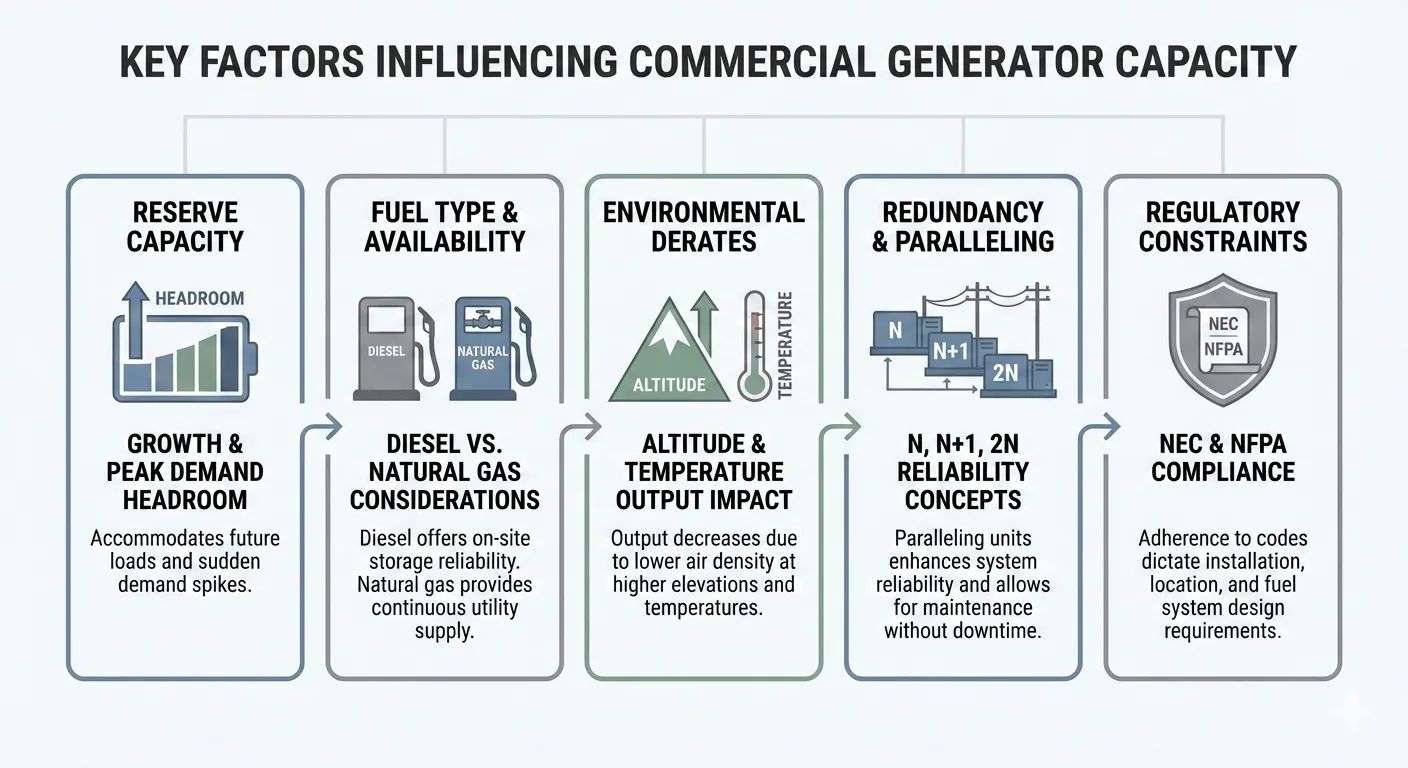
Beyond raw load totals, practical capacity depends on reserve for future growth, fuel logistics and availability, altitude, and ambient-temperature derates, redundancy architecture, and code requirements (NEC/NFPA). Each factor alters the generator’s deliverable power or the margins you need to design for reliability and compliance. Weigh these variables together to find a solution that balances upfront cost with long-term operational resilience and regulatory risk mitigation.
Key factors to prioritize include:
- Reserve capacity: Headroom for growth and peak events.
- Fuel type and availability: Impacts runtime, storage, and derates.
- Environmental derates: Altitude and temperature reduce output.
- Redundancy and paralleling: Supports N+1 or 2N reliability strategies.
- Regulatory constraints: NEC and NFPA affect installation and testing requirements.
Why Is Reserve Capacity Important for Commercial Generators?
Reserve capacity is the extra margin above calculated peak demand that protects against unexpected load increases, simultaneous startups, and short-term expansion. Designers commonly budget roughly 20–25% as a practical buffer, though specific industries or site needs may call for different margins. To set reserve, estimate near-term growth, and add that percentage to the running kVA p before applying derates. Reserve also makes staged expansion easier and avoids premature replacement as site loads evolve.
Reserve matters because it reduces overload risk during concurrent startups or unplanned equipment additions and keeps the engine from running constantly at its limit, which accelerates wear. It also supports phased growth, so you don’t outgrow your generator quickly.
How Do Fuel Type and Location Affect Generator Size?
Fuel choice and site conditions directly affect usable capacity: natural gas units can be derated by low gas pressure and high ambient temperatures, while diesel units need on-site storage and refueling plans that define runtime limits. Altitude and high temperatures reduce engine power; manufacturers publish derates per 1,000 feet and per degree Celsius, so apply local adjustments to nameplate ratings. Fuel supply reliability, permitting, and emissions rules may mean choosing a larger nominal unit to guarantee dependable output on site. Accounting for these constraints ensures the selected generator meets your usable-power expectations in real-world conditions.
This comparison highlights trade-offs in fuel logistics, emissions, and maintenance burden so stakeholders can pick the strategy that fits site constraints and lifecycle goals.
How Do Industry-Specific Needs Affect Generator Sizing?
Different industries create distinct critical-load profiles and redundancy expectations, which affect sizing and configuration. Data centers coordinate UPS and battery systems for short transitions and demand high redundancy; telecom sites focus on runtime and remote fuel logistics; manufacturing and distribution centers prioritize motor-starting capacity for conveyors and lifts. Align redundancy architecture (N, N+1, 2N) and reserve margins with industry expectations so generator capacity matches your acceptable outage risk and operational priorities.
What Are the Generator Capacity Requirements for Data Centers?
Data centers combine UPS batteries for the immediate transfer and generators for sustained power. The key calculation coordinates UPS output, transfer times, and continuous generator kW to protect rack-level service. Power density varies widely, ranging from a few kW per rack in light deployments to 10–20+ kW in high-density setups. Therefore, start with measured PDU or meter data and factor in N+1 or 2N redundancy. Designers commonly separate generator strings by electrical system and add reserve for concurrent cooling loads and staged server power-up. UPS integration determines the continuous generator kW and the acceptable fuel storage runtime.
How Should Telecom and Industrial Facilities Size Their Generators?
Telecom sites prioritize reliable runtime and fuel logistics for remote operation, focusing on steady-state loads like radio gear, HVAC, and monitoring with modest motor demands. Material handling facilities face frequent heavy motor starts, conveyors, cranes, and chargers, so starting wattage often drives sizing and may require soft-starts or larger capacity to prevent voltage dips. Use appropriate reserve margins, staged motor restoration, and load bank testing to validate real-world performance. Both sectors benefit from measured load audits to capture peak concurrent demand.
This industry table guides early sizing decisions and shows how operational profiles shape reserve and redundancy needs.
What Are the Differences Between Diesel and Natural Gas Generators for Commercial Use?
Choosing between diesel and natural gas depends on fuel logistics, emissions rules, delivered capacity under site conditions, and lifecycle cost. Diesel units offer strong power density and handle high startup loads, but need on-site fuel storage and more frequent fuel-system care. Natural gas units burn cleaner and can rely on pipeline supply where available, but they may face derates with low pressure or high temperatures. Match the fuel option to runtime expectations, site constraints, and permitting to arrive at the most reliable and cost-effective solution.
Key decision points at a glance:
- Diesel: high startup capacity, predictable derating, requires on-site refueling and fuel logistics.
- Natural gas: cleaner operation and continuous pipeline supply when available, but subject to pressure-related derates.
- Decision drivers: expected runtime, emissions limits, refueling access, and local code/permitting.
How Do Fuel Efficiency and Capacity Vary Between Diesel and Natural Gas?
Diesel engines generally deliver higher effective kW per displacement at prime/standby ratings and maintain output across a wide ambient range. Natural gas engines can be derated by low gas pressure or high altitude and often show slightly lower fuel efficiency per kWh. Practical selection uses manufacturer derate tables for elevation and ambient temperatures, models expected runtime hours, and compares fuel-cost projections. For long-duration standby, fuel logistics and runtime cost usually outweigh small efficiency differences, so include lifecycle fuel strategy in your selection matrix.
What Are the Pros and Cons of Each Generator Type?
Clear pros and cons help procurement and installation planning.
- Diesel pros: strong power density for motor starts, predictable output, and is widely available.
- Diesel cons: requires on-site storage, higher particulate emissions, and more frequent fuel maintenance.
- Natural gas pros: continuous supply without bulk storage where a pipeline exists, lower particulates, simpler refueling logistics.
- Natural gas cons: possible output derates with pressure/altitude; reliant on utility supply.
These trade-offs naturally lead to common sizing mistakes and how maintenance affects long-term capacity.
What Common Mistakes Should You Avoid When Sizing a Commercial Generator?
Common design errors include trusting nameplate ratings alone, overlooking starting currents, skipping load bank testing, and forgetting site derates or reserve growth. Those mistakes produce undersized systems that trip under load or oversized systems that run inefficiently and raise capital costs. Best practices are to run measured load studies, implement motor sequencing, budget reserve capacity, and schedule regular load bank tests and preventive maintenance to confirm available capacity.
Frequent pitfalls and how to mitigate them:
- Undersizing: Fails to handle peak startups. Mitigate with accurate metering and reserve margin.
- Oversizing: Causes poor fuel efficiency and low-load issues. Mitigate by matching generator ratings to expected duty cycles.
- Ignoring derates: Leads to unexpected shortfalls at altitude or high temperature. Mitigate by applying the manufacturer’s derate ps.
Avoid these errors with procedural checks and real-world validation. Next, we discuss maintenance’s role in preserving capacity.
Why Is Undersizing or Oversizing a Generator Problematic?
Undersizing creates immediate operational risk dropouts, ATS failures, and overload trips—while oversizing leads to inefficient fuel use, wet-stacking, and shortened component life because the engine rarely operates near optimal load. Economically, oversizing raises capital cost and can increase maintenance needs from low-load operation; undersizing risks emergency failures and costly downtime. The right approach sizes to realistic loads plus reserve, considers load-management options (sequencing, soft starters), and verifies assumptions with temporary metering or a load study.
How Does Neglecting Maintenance Impact Generator Capacity and Reliability?
Poor maintenance reduces available capacity through clogged air filters, degraded fuel, weak batteries, and outdated control firmware. Each issue lowers output and raises failure risk. Regular load bank testing exercises the generator under real load, surfaces cooling or combustion problems, and validates consumption assumptions. A structured maintenance plan with periodic testing, battery service, and fuel polishing preserves nameplate capacity so the generator performs as intended during outages.
When Should You Consult Experts for Commercial Generator Sizing and Installation?
If downtime risk is high, systems require UPS integration or paralleling, or strict code compliance is needed, bring in professionals for site surveys, load studies, and project management. Experts provide measurement-grade metering, NEC/NFPA knowledge, and practical experience with staging, paralleling, and fuel logistics, reducing technical and permitting risk. Consult when your project includes critical redundancy, complex startup sequences, or when local derates and emissions rules materially affect capacity.
Use this checklist to decide when to engage professionals:
- The facility has critical loads where downtime causes major business loss.
- The project requires UPS integration, paralleling, or complex ATS systems.
- Site conditions (altitude, temperature, fuel constraints) require derate analysis.
- Permitting or regulatory complexity demands formal documentation.
What Services Does Swift Industrial Power Offer for Generator Sizing and Installation?
Swift Industrial Power Inc. provides load studies, sizing consultations, generator installation, maintenance, and project management for reserve power and stationary power systems. Our Reserve Power Division supports batteries, chargers, DC systems, generators, and UPS equipment and delivers site surveys, formal load studies, and scheduled maintenance to protect critical infrastructure. We also partner on development and marketing projects, bringing experienced technicians and project managers who convert technical calculations into reliable, code-compliant field installations.
How Can Professional Consultation Ensure Compliance with NEC and Industry Standards?
Professional consultants produce load studies, design reports, and testing documentation that align installations with NEC and NFPA requirements, smoothing permitting and reducing audit risk. They coordinate inspections and provide testing evidence, load bank reports, single-line diagrams, and commissioning records that demonstrate compliance with authorities having jurisdiction. This disciplined approach lowers installation risk and ensures systems are auditable, tested, and ready for both routine operation and emergency events.
- Design Documentation: Consultants deliver load studies and single-line diagrams for permitting.
- Testing & Commissioning: Professionals run load bank tests and commissioning procedures.
- Regulatory Coordination: Consultants handle permitting and inspector interactions.
These services build a defensible record that supports long-term reliability and regulatory compliance, bridging engineering calculations and field performance.
Conclusion
Proper generator sizing is essential for dependable backup power and reduced operational risk. By understanding load makeup, fuel options, site derates, and industry needs and by using measured data and professional studies, you can choose a solution that balances reliability, cost, and growth. If you need help with load studies, equipment selection, or installation, contact Swift Industrial Power Inc. to tailor backup power solutions to your operational requirements.
Servicing Tennessee, Florida, and Alabama